


3d Printer Use in Dentistry
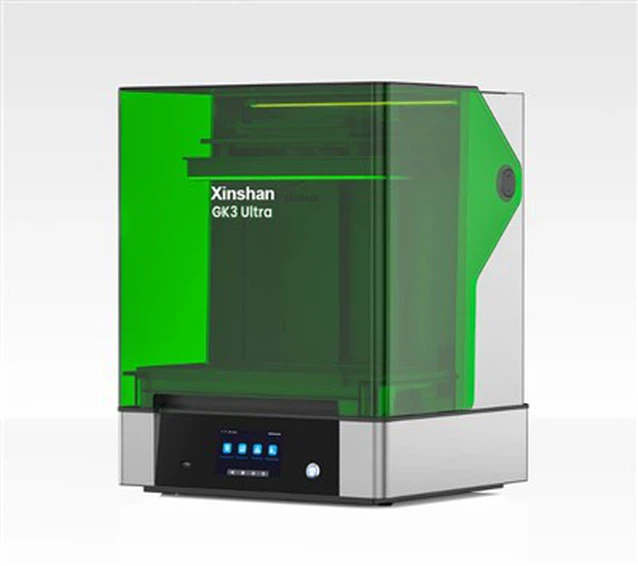
◆Product size: 350*315*H455mm
◆Printing volume: 228*128*H245mm
◆HD resolution: 7680*4320
◆UI interface operation: touch screen
Description
Technical Parameters
3D printers can accurately print customized dental restorations, such as crowns and bridges, based on the digital model of the patient's oral cavity. During operation, the doctor first obtains data through oral scanning and transmits it to the supporting software design. Then the 3D printer uses materials with good biocompatibility, such as ceramics and resins, to print layer by layer according to the preset model. This greatly shortens the production cycle of restorations. In the past, it took several days to wait, but now it can be completed in a few hours. It also improves the accuracy of adaptation, reduces the number of patients' return visits, and makes dental diagnosis and treatment more efficient and accurate.
Highly customized:
Based on the unique oral structure data of each patient, dental products that fit individual needs can be accurately printed. Whether it is a crown, braces or denture, it can achieve "one version for one person", perfectly fit the patient's mouth, and greatly improve the wearing comfort and restoration effect.
High precision:
Usually it can reach an accuracy level of 25-50 microns. With advanced printing technology and precise calibration system, it ensures that the size of the restoration is accurate and seamlessly connected with adjacent teeth and tissues, effectively reducing the subsequent adjustment process.
Efficient and time-saving:
The production process of traditional dental restorations is cumbersome and time-consuming, while 3D printers greatly shorten the production cycle. Simple restorations only take a few hours from design to finished product, and complex ones can be completed within 1-2 days, allowing patients to receive treatment faster.
Strong material compatibility:
It is compatible with a variety of materials with good biocompatibility, such as ceramics, resins, metal powders, etc., which can not only meet different restoration needs, such as ceramics for front teeth with high aesthetic requirements, metals for back teeth with high bite force, but also ensure no adverse reactions to the human body.

Product Specifications
|
Product Size:
|
350*315*H455mm
|
Power:
|
Print 120w, Heating 200w
|
|
Package Size:
|
445*420*550mm
|
UI Operation:
|
Touch screen
|
|
Package Weight:
|
19kg
|
File Format:
|
STL
|
|
Printing Volume:
|
228*128*H245mm
|
HD Resolution:
|
7680*4320
|
| Rated capacity | 800/1000/1150/1275kg |
Light spot size:
|
29.6μm
|
|
Exposure time:
|
2-3s/layer(0.05mm)
|
Printing Tolerance:
|
±0.05
|
|
Technology:
|
LCD Photocuring
|
Layer Height:
|
0.03,0.05,0.1mm
|
|
Wavelength Range:
|
402.5-405mm
|
Resin Vat Capacity:
|
0.7kg
|
|
File Transfer:
|
USB
|
Constant Temperature:
|
25℃,30℃,35℃ automatic constant temperature system
|
|
Printer System:
|
Linux
|
Voltage:
|
110, 220V (produced on demand)
|
why choose our products
Precise fit: By digitally scanning and modeling the patient's oral cavity, 3D printers can produce restorations that are highly compatible with the patient's oral structure, such as crowns and bridges. The error can be controlled within a very small range, effectively avoiding the poor fit that may occur in traditional manual production, and improving the restoration effect and patient comfort.
Shortened treatment course: In the past, the production of dental restorations often required the impression to be sent to an external processing center, which took days or even weeks. 3D printers can be operated on-site in the clinic. Simple cases can be printed in a few hours, and complex cases only take 1-2 days, which greatly speeds up the treatment process and reduces patient waiting time.
Rich design: It breaks the limitations of traditional technology. Doctors can use professional software to personalize the restoration according to the specific needs of patients, such as simulating gum texture on dentures, adding personalized decoration to crowns, etc., to meet functional restorations while taking into account aesthetic needs.
Reduce costs: Although the purchase cost of the 3D printer itself is relatively high, in the long run, on the one hand, it reduces dependence on external processing and saves costs in intermediate links such as transportation and communication; on the other hand, precise printing reduces material waste, which reduces the overall dental treatment cost to a certain extent and reduces the financial burden on patients.
How accurate can a 3D printer print dental restorations?
The accuracy of a 3D printer printing dental restorations can usually reach about 25 to 50 microns. This high accuracy is achieved due to many factors. On the one hand, 3D printing technology itself is constantly developing and optimizing. The layer-by-layer stacking printing method it adopts, combined with advanced optical systems and high-precision nozzles, can accurately control the deposition position and thickness of the material. On the other hand, during the printing process, the calibration system can play a role in real time, adjust the printing status, and ensure the dimensional accuracy of the printed parts. In the early stage, high-precision three-dimensional scanning equipment is used to obtain the detailed data of the patient's oral cavity, and then professional dental design software is used to complete the model design. These links work together to lay a solid foundation for the high-precision printing of the final restoration, ensuring that it can accurately adapt to the patient's oral needs.
FAQ
1.What is the printing accuracy of this 3D printer?
Our dental 3D printer has extremely high accuracy, usually reaching 25-50 microns stably, and can accurately restore the complex structure of dental restorations, ensuring perfect fit with the patient's mouth and effectively improving the quality of restoration.
2.What dental materials are compatible and how biocompatible are these materials?
It is compatible with a variety of mainstream dental materials, such as ceramics, resins, and medical metal powders. These materials have been rigorously tested and have excellent biocompatibility, ensuring that they will not cause adverse reactions after implantation in the human body and ensure patient safety.
3.Is the accompanying dental design software easy to use and is it easy to use?
Our independently developed dental design software has a user-friendly interface and powerful functions. It uses an intuitive graphical operation interface. Even medical staff without a deep software foundation can master it after half a day of training and easily complete the design of various dental restorations.
4.Ask if the software supports data docking with the hospital's existing systems, such as the electronic medical record system?
Of course it does. The software has reserved a wealth of data interfaces, which can be seamlessly connected with most hospital information management systems and electronic medical record systems on the market, allowing you to quickly import patient data and realize digital integration of the diagnosis and treatment process.
Hot Tags: 3d printer use in dentistry, China, suppliers, manufacturers, factory, custom, wholesale
Product Specifications
|
Product Size:
|
350*315*H455mm
|
Power:
|
Print 120w, Heating 200w
|
|
Package Size:
|
445*420*550mm
|
UI Operation:
|
Touch screen
|
|
Package Weight:
|
19kg
|
File Format:
|
STL
|
|
Printing Volume:
|
228*128*H245mm
|
HD Resolution:
|
7680*4320
|
| Rated capacity | 800/1000/1150/1275kg |
Light spot size:
|
29.6μm
|
|
Exposure time:
|
2-3s/layer(0.05mm)
|
Printing Tolerance:
|
±0.05
|
|
Technology:
|
LCD Photocuring
|
Layer Height:
|
0.03,0.05,0.1mm
|
|
Wavelength Range:
|
402.5-405mm
|
Resin Vat Capacity:
|
0.7kg
|
|
File Transfer:
|
USB
|
Constant Temperature:
|
25℃,30℃,35℃ automatic constant temperature system
|
|
Printer System:
|
Linux
|
Voltage:
|
110, 220V (produced on demand)
|
Previous
LCD Resin 3D PrinterSend Inquiry


