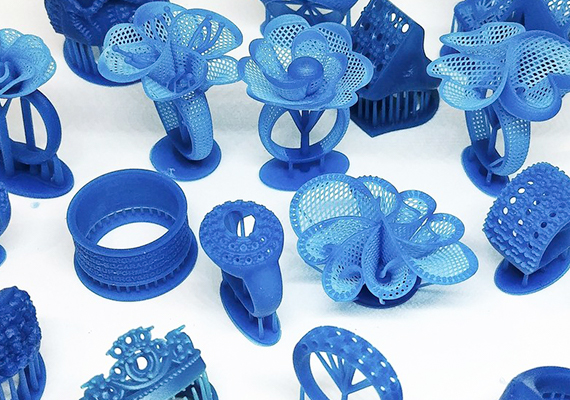
Jewelry 3D printing applications
3D printing technology has become an important
innovation tool in the jewelry industry, allowing designers to create complex and detailed designs through
precise digital modeling and printing, eliminating the tedious steps of traditional hand-made production.
This not only shortens the production cycle, but also reduces costs, especially for customized jewelry and
small batch production. The application of jewelry 3D printing covers areas such as prototyping,
personalized customization and accessory manufacturing. Designers are able to quickly make accurate
models, make modifications and optimizations, and reduce errors and waste. 3D printing supports a variety
of materials, such as metal, plastic and wax, to meet different design needs. For consumers, jewelry 3D
printing provides highly personalized customization options. Customers can choose unique designs and
materials according to their personal preferences to achieve tailor-made beads. This technology has driven
the jewelry industry towards innovation and personalization.
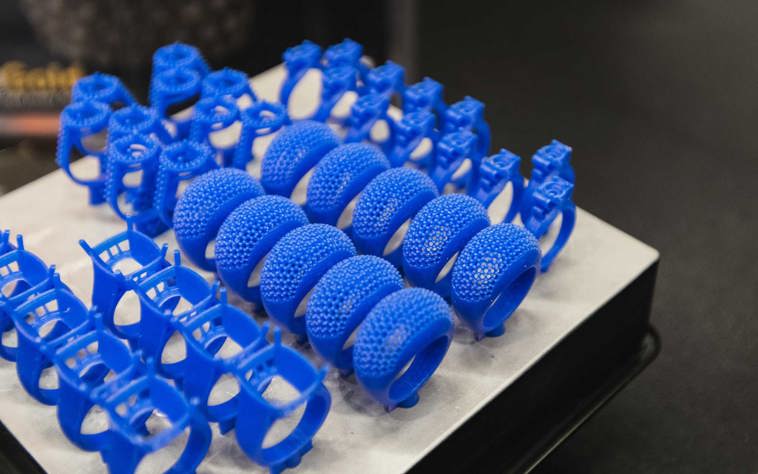
Why use 3D printing?
There are several advantages to using 3D printing to produce jewelry
Create complex designs
Compared with traditional CNC engraved wax molds, 3D printing is not limited by physical constraints and can create complex shapes and details that were impossible to manufacture in the past. Design customization becomes more flexible to meet various creative needs.
Shorten the production cycle
3D printing can produce multiple models at the same time in a short time, significantly reducing delivery time and reducing production costs compared to traditional wax CNC or aluminum mold casting.
Support small batch production
3D printing can complete multiple designs in a single printing, providing a very cost-effective solution for small batch production. For the jewelry industry, this means responding to customer demand for personalized, one-of-a-kind pieces.
3D Printing Technology
3D printing is commonly used to create jewelry through two methods: investment casting and direct printing
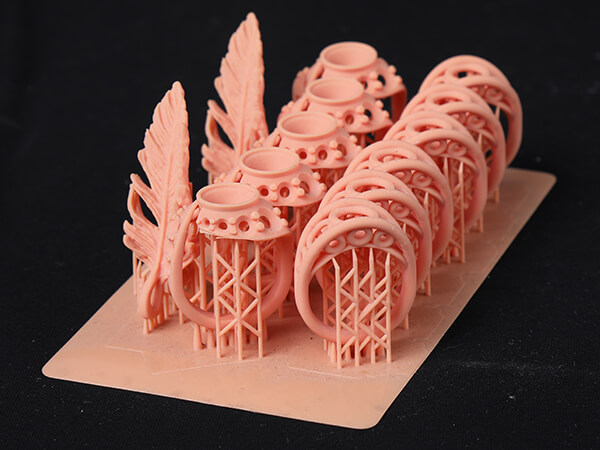
Investment Casting Process
Pattern Formation: Traditionally,
this step is done by pouring wax into a metal mold to create the pattern. With 3D printing, patterns can
be printed directly from wax or castable resin, simplifying the process.
Mold Assembly: The printed or molded pattern is assembled onto a "casting
tree" so that multiple parts can be cast at once. Some 3D printing processes are even able to print
both the pattern and the casting tree in the same process, further simplifying operations.
Shell Construction: Once the pattern is assembled, the entire structure is dipped into
the slurry several times, and then the slurry coating is allowed to dry to form the ceramic shell.
Burnout: The ceramic shell is placed in a furnace to burn out the wax or resin, leaving
a hollow negative mold to form the casting space.
Pouring: After burnout, the casting material (such as brass) is poured into the hollow
mold, cooled and solidified to form a three-dimensional part. Precious metal plating is often used for
finishing.
Knockout: The ceramic mold shell is removed by vibration or knocking to reveal the cast
jewelry part.
Cut-off: The casting is cut from the mold tree and the individual parts are prepared
for further processing.
Finishing: Finally, the cast jewelry is polished and trimmed using traditional jewelry
processing techniques to ensure the quality and appearance of the finished product.
Direct Printing Technology
Another way to 3D print jewelry is to use metal powders directly, such as gold, silver or platinum alloys.
This method is more expensive, especially for custom jewelry, because it requires precise precious metal
powder management and requires extensive post-processing after printing.
DMLS/SLM Technology
Direct Metal Laser Sintering (DMLS) and Selective Laser Melting (SLM) are commonly used metal 3D printing
technologies that sinter metal powders to form parts. This technology requires the addition of support
structures to ensure stability, but the high temperature may cause the part to warp or deform, and usually
requires extensive post-processing to remove the support and improve the surface quality.
Support Removal
All 3D printing technologies require the removal of support structures, DMLS/SLM requires manual removal,
and the support contact surface requires additional post-processing to ensure smoothness.
Loss of Handcrafting
Despite the convenience and innovation provided by 3D printing, some jewelry designers believe that it
deprives jewelry of the handmade charm, especially for high-end custom jewelry.