

Desktop 5-axis CNC vs. Industrial service: how to choose
Apr 08, 2026
Leave a message

With the rapid evolution of modern manufacturing, the desktop 5-axis CNC machine has become an increasingly popular solution for engineers, designers, and small-scale manufacturers. These compact machines combine multi-axis machining capability, flexibility, and affordability, enabling users to produce complex parts without relying entirely on external suppliers.
However, the decision between owning a desktop 5-axis CNC and outsourcing to industrial machining services depends on factors such as production scale, precision requirements, and long-term cost efficiency.
What Is a Desktop 5-Axis CNC Machine?
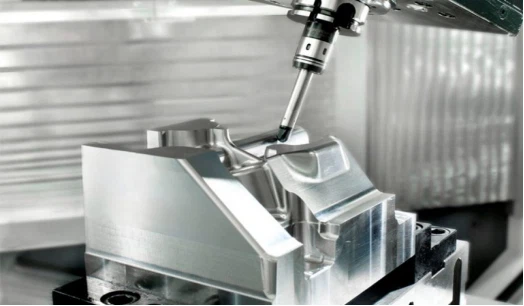
A desktop 5-axis CNC machine is a compact machining system capable of moving tools or workpieces along five different axes simultaneously, allowing the creation of intricate geometries and complex surfaces.
Compared to traditional 3-axis machines, 5-axis systems enable:
●Multi-angle machining in a single setup
●Reduced repositioning and setup time
●Improved surface finish and accuracy
These machines are typically used in prototyping labs, R&D centers, educational institutions, and small manufacturing workshops.

Why Choose a Desktop 5-Axis CNC Machine?
One of the biggest advantages of desktop 5-axis CNC machines is independence in production. Users can design, test, and manufacture parts in-house without waiting for third-party suppliers.
Key benefits include:
●Compact footprint – Fits easily in workshops, labs, or even small studios
●Rapid prototyping capability – Quickly iterate and test new designs
●Lower initial investment compared to industrial CNC systems
●Flexibility for custom parts and small-batch production
This makes them ideal for applications such as:
●Product development
●Medical and dental components
●Jewelry and precision parts
●Educational and research projects
Limitations of Desktop 5-Axis CNC Machines
Despite their advantages, desktop machines come with clear limitations when compared to industrial-grade CNC systems.
●Limited Processing Capacity
Desktop machines are better suited for soft metals, plastics, and light materials, but struggle with hard alloys or heavy-duty machining tasks.
●Lower Precision and Stability
Typical tolerances are wider than industrial machines, and long-term repeatability may decrease due to vibration and thermal effects.
●Small Working Envelope
Most desktop machines have limited machining space, restricting part size and production capability.
●Not Ideal for Mass Production
They are efficient for prototypes and small batches, but not suitable for high-volume or continuous manufacturing.
Desktop CNC vs Industrial CNC Services
When comparing desktop machines with professional CNC services, the difference lies in scale, performance, and output consistency.
Desktop CNC → Flexibility, learning, small-scale production
Industrial CNC → High precision, large volume, professional finishing
Industrial services typically provide:
●Advanced materials processing (steel, titanium, etc.)
●Tight tolerances and quality inspection
●Surface finishing and post-processing
●Desktop machines, on the other hand, offer speed in iteration and design control, which is critical in early-stage development.
How to Choose the Right Solution
Choosing between owning a desktop 5-axis CNC and outsourcing depends on your specific needs:
Choose Desktop CNC If:
●You focus on prototyping and product development
●You need fast iteration and design flexibility
●Your production volume is low
Choose Industrial CNC Services If:
●You require high precision and consistency
●You are working with hard materials or complex parts
●You need mass production or tight deadlines
In many cases, companies adopt a hybrid approach-using desktop CNC machines for design and testing, and outsourcing final production to industrial manufacturers.
Applications in Modern Manufacturing
Desktop 5-axis CNC machines are widely used across multiple industries:
●Aerospace – Complex lightweight components
●Medical – Surgical tools and implants
●Automotive – Prototype parts and molds
●Electronics – Precision enclosures
●Education & R&D – Training and innovation
Their ability to handle multi-surface machining and complex geometries makes them a valuable tool in advanced manufacturing environments.
Conclusion
The desktop 5-axis CNC machine is a powerful solution for innovation-driven industries, offering flexibility, affordability, and control over the manufacturing process. However, it is not a replacement for industrial CNC systems.
For most businesses, the best strategy is to balance both:
👉 Use desktop CNC for creativity and rapid development
👉 Use industrial services for precision, scale, and final production
This approach ensures maximum efficiency while minimizing cost and risk in modern manufacturing workflows.