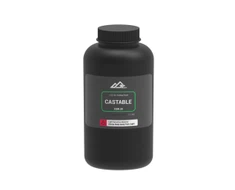


3d Dental Resin
3d Printer Dental Resin Can be used in lost waxcasting, burning clear, ash free and noresidue, low contraction percentage, shape dimension fixed, high finenesssmooth surface spare parts.
● Burning clear
● Low contraction percentage
● Low smell, non toxic
● High temperature resistance
Description
Technical Parameters
3D Dental Resin is a functional material specifically developed for 3D printing in the dental field. It enables precise molding of components such as crowns, bridges, implant guides, temporary restorations, and orthodontic accessories. Using stereolithography (SLA)/DLP technology for layered curing, it achieves highly accurate reproduction of tooth anatomy and detail, ensuring both biosafety and structural stability in the finished product. This product is compatible with mainstream dental 3D printers and can meet the needs of immediate restorations in dental clinics, mass production in denture fabricators, and innovative R&D in dental research institutions. It provides efficient, customized material solutions for dental care, driving the evolution of precision and personalized dental restorations.
3D Dental Resin advantage
●Ultra-high molding precision: Print layer thickness can be as low as 25μm, with component dimensional error controlled within ±0.03mm. This allows for clear reproduction of fine structures such as tooth occlusal texture and implant guide positioning holes, ensuring a precise fit between restorations and oral tissue, reducing clinical adjustments.
●Broad-spectrum device compatibility: Compatible with 355nm-405nm wavelength UV-curing printers (covering both SLA and DLP technologies), and compatible with mainstream brands such as Formlabs, EnvisionTEC, and Flashforge, eliminating the need for hardware replacement and reducing device adaptation costs.
●Graded performance design: Models are segmented by application scenario. For example, temporary restoration resins prioritize toughness and aesthetics (color matching natural teeth), implant guide resins focus on impact resistance (withstanding surgical forces), and model resins prioritize hardness and dimensional stability, meeting the functional requirements of diverse dental components.
●Strict safety certifications: This material has passed ISO 10993 biocompatibility testing, FDA 510(k) certification, and CE IVDR certification. After curing, it is non-cytotoxic and non-sensitizing, and does not irritate oral mucosa or dental pulp tissue, meeting safety standards for dental medical materials.

Technical Specifications
Liquid Properties
| Appearance | Liquid resin | |
| Viscosity @25°C,cps | 125 ±25 | |
| Density @25°C,g/cm³ | 1.05 -1.13 | |
| Alcohol solubility | Soluble in alcohol | |
| Water solubility | Slightly soluble in water | |
| Color | Green | |
Light-cured Solid Properties:
| Item | Post-cured | Method |
| Hardness,D | 81 | Scale D |
| Tensile Strength,MPa | 42-62 | ASTM D638 |
| Young's Modulus,MPa | 2545±100 | ASTM D638 |
| Elongation at Break,% | 15±5 | ASTM D638 |
| Flexural Strength,MPa | 53±5 | ASTM D790 |
| Flexural Modulus,MPa | 2425±100 | ASTM D790 |
| 1ZOD Impact Strength,J/m | 46±3 | ASTM D256 |
| HDT,°C | 75 | ASTM D-648 |
| Volume shrinkage,% | 1.88-2.45 | / |
| Linear shrinkage,% | 0.8-1.00 | / |
| Thermal expansion | 95*E-6 | / |
| Glass transition temp,°C | 110 | / |
3D Dental Resin Process
Xinshan is a professional dental resin supplier, providing one-stop solutions
3D Data Acquisition and Processing
Scan the patient's teeth using an oral scanner to generate 3D point cloud data. Use dental design software (such as Exocad and 3Shape Dental System) to optimize component structure, determine parameters such as restoration thickness and occlusal clearance, and export an STL file. Import the file into 3D printing slicing software, set parameters such as layer thickness and exposure time, and complete the slicing process.
Resin Filling and Equipment Debugging
Pour 3D dental resin into the printer's resin tank, ensuring a smooth, bubble-free liquid surface. Calibrate the printer's laser power (SLA) or projection accuracy (DLP) based on the resin type, and adjust the print platform height to ensure precise alignment between the platform and the resin liquid surface to ensure adhesion of the initial printing layer.
Layered Stereolithography Printing
The printer starts according to the slicing data. SLA technology cures the resin surface point by point using a laser, while DLP technology cures the entire layer using a projected beam array. After each layer is cured, the platform lowers by the corresponding layer thickness. This process is repeated until the component is fully formed. The liquid level is monitored in real time during the printing process to prevent contaminants from affecting the print surface.
Post-Processing and Performance Enhancement
After printing, remove the component and clean any residual resin from the surface with 95% isopropyl alcohol (soak for 5-10 minutes, using a soft-bristled brush to clean crevices). Place the component in a dedicated UV curing chamber for a secondary cure (50-60°C for 20-30 minutes) to enhance component strength and stability. Finally, polish with fine sandpaper and a buffing wheel to achieve an optimized surface finish that meets clinical standards.
Global compliance certification

Professional and reliable resin factory
We are looking for a cooperative partner to expand our business.


Picture Show


Other Popular Products
Resins For Jewelry Making / 3d printing dental resin/ Engineering resins / Resin For 3d Print


FAQ
What you may want to know
Are there differences in printing parameters for different types of 3D Dental Resin?
+
-
Due to varying resin compositions, printing parameters (exposure time, laser power, and layer thickness) vary between resin types. After purchasing, you'll receive parameter templates categorized by device brand, including recommended layer thickness, exposure time, and other key parameters. Our technical team can also provide customized parameter tuning guidance based on your specific device model to ensure consistent print quality.
Will the resin cure or deteriorate if left unused for a long time after opening? How can I extend its shelf life after opening?
+
-
If improperly stored after opening, the resin can slowly cure or deteriorate due to exposure to UV rays and moisture. We recommend keeping the resin tightly sealed after opening (with a moisture-proof stopper installed) in a dark, dry environment at 15-25°C. Clean any remaining resin from the bottle cap promptly after each use to avoid contamination. It's recommended to use the resin within one month after opening. If the resin becomes cloudy or precipitates, test the curing properties after stirring. If the curing properties do not meet the requirements, do not use it.
Can printed temporary restorations be worn long-term? What is the aging resistance of the resin?
+
-
The recommended wear period for temporary restorations is 3-6 months (depending on the resin type and clearly marked on the packaging). Long-term wear may cause slight aging of the resin due to the oral environment (saliva, temperature fluctuations), affecting toughness and aesthetics. Our product has passed accelerated aging testing (simulating a one-year oral environment) and shows a strength retention rate of ≥85% after aging. For long-term restorations, we recommend choosing a dedicated permanent restorative resin or ceramic material.
Can I try samples before purchasing? Is the quality of the samples consistent with the mass production?
+
-
Free sample trials are available. Company credentials are required upon application. Samples and mass production are produced on the same production line and from the same batch of raw materials, with identical quality standards and performance parameters. Production information can be traced through batch numbers to ensure the same results as mass production.
When purchasing in bulk, are there any minimum order quantities for different resin types?
+
-
The minimum order quantity for standard resin types is 5L per type, while the minimum order quantity for custom resins (such as resins with specific colors or properties) is 20L. Mixed purchases of different types are supported. Temporary restoration resins, implant guide resins, model resins, and other types can be combined in the same order to meet diverse usage needs. Bulk discounts are available for mixed purchases of 50L or more.
If problems such as interlayer cracking or surface roughness occur during printing, how can you quickly identify the cause?
+
-
You can quickly locate the problem using a three-step troubleshooting method: Step 1: Check the printing parameters (to see if they match the resin type); Step 2: Observe the resin condition (to see if it's deteriorating or contains impurities); and Step 3: Verify the equipment status (to see if the laser head/projection module is functioning properly). Our technical team provides 24/7 online support, allowing you to view the printing process in real time via video link and analyze the cause of the problem. If the problem is resin quality, we will reissue the product free of charge and cover any printing losses. If the problem is due to operational or equipment issues, we will provide a targeted solution.
Hot Tags: 3d dental resin, China, suppliers, manufacturers, factory, custom, wholesale
Previous
3d Printer Resin DentalSend Inquiry