


Handheld Laser 3D Scanner
Description
Technical Parameters
Products Description
Mangofree handheld laser 3D scanner is a new portable high-precision 3D reconstruction system. It operates based on the principles of triangulation and binocular stereo vision, with the help of dynamic tracking imaging technology and advanced visual optimization algorithms, using two sets of high-speed industrial cameras to capture multiple laser beams, so as to accurately obtain complex surface features and achieve high-precision 3D reconstruction. Its self-positioning optimization algorithm is very advanced, no fixed installation is required, handheld operation is sufficient, objects and equipment can be moved freely, angles can be adjusted, and repeated scanning accuracy is extremely high. The system has excellent integration and portability, and novices can quickly obtain reliable measurement data after a short training, which is very advantageous in the field of 3D scanning.
Product Features
High-precision reconstruction:
Based on the principle of triangulation and binocular stereo vision, two sets of high-speed industrial cameras are used to capture multiple laser beams to obtain high-precision features of complex surfaces and achieve high-precision 3D reconstruction.
Flexible and convenient:
Advanced self-positioning optimization algorithm, no need for fixed installation, handheld use, the measured objects and equipment can be moved and adjusted at will, and it is highly integrated and portable.
Easy operation:
Even inexperienced novices can quickly get started and obtain reliable measurement data after a very short training period.
,
Dynamic tracking imaging:
Using dynamic tracking imaging technology and advanced visual optimization algorithms to ensure scanning accuracy and efficiency under various operating conditions.


Multi-function button
| Button | Function | Click |
| 1 | Implemented configuration of the upper and lower options of the 1st level menu bar | Down option |
| 2 | Implemented configuration of the upper and lower options of the 1st level menu bar | Up option |
| 3 | Start/Pause Scan | Start/Pause Scan |
| 4 | Implemented configuration of 2-level menu bar plus and minus adjustment | 2nd level menu bar function plus |
| 5 | Implemented configuration of 2-level menu bar plus and minus adjustment | 2nd level menu bar function reduction |
How Handheld 3D Scanners Work
Structured light 3D scanning
When the handheld 3D scanner is turned on, it will actively project a light pattern of a specific style onto the target object. Then, the built-in camera of the scanner quickly captures the image of the object after being illuminated by the light pattern. The 3D scanning software starts running, and it accurately compares the light pattern (i.e. the original pattern) captured by the camera on the object with the standard light pattern projected previously. Since the surface of the object is not completely flat, the projected light pattern will deform and distort accordingly according to its surface shape when it contacts the object.
Laser 3D scanning
When working, the handheld 3D scanner emits a clear laser line to the object to be scanned. Once the laser line contacts the surface of the object, a reflection phenomenon will occur. The software in the scanner will instantly calculate the time it takes for the laser to be emitted and reflected back to the scanner, as well as the specific angle at which the laser is reflected back. With the accurate measurement of the laser reflection time and angle, the software can accurately locate each position point on the surface of the object illuminated by the laser, and at the same time determine the shape contour formed by these position points.
Photogrammetry
Photogrammetry requires a handheld 3D scanner to take a number of overlapping photos around an object from different angles. After the photos are taken, the accompanying software will conduct a comprehensive and in-depth comparison and analysis of these photos. By identifying the changes and associations of the object's feature points, lines and other elements in different photos, the software can determine the object's geometric shape.
Application of Handheld Laser 3D Scanner



Artistic creation:
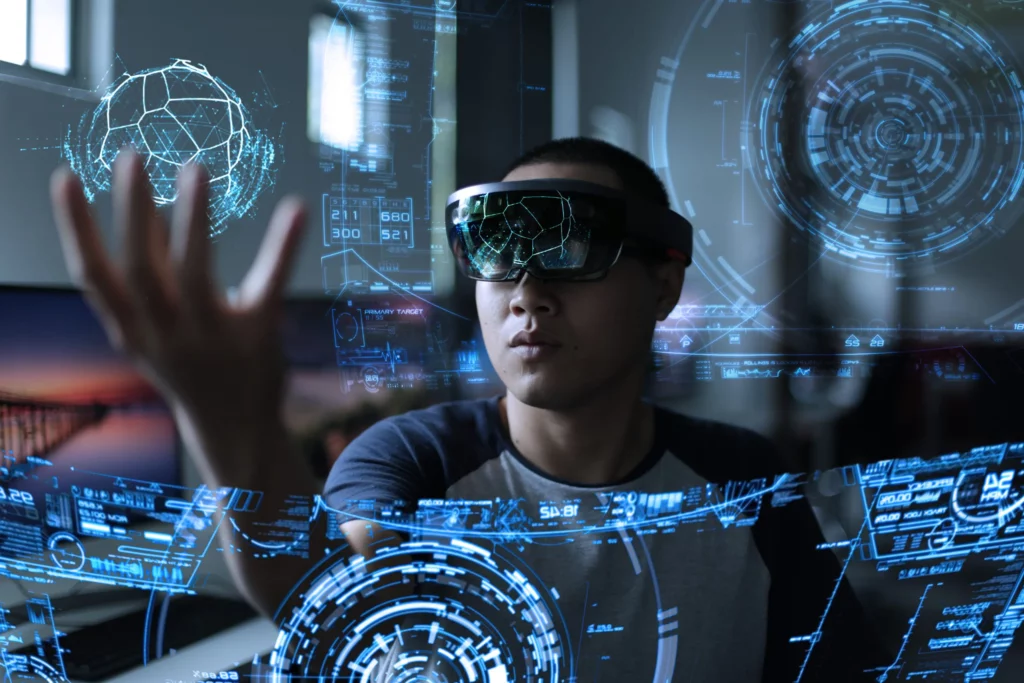
Handheld 3D scanners use structured light to capture sculpture curves, laser technology to draw cultural relics textures, and photogrammetry to reproduce color charm. It can copy art exhibitions or obtain materials for creation, help art digitization, and allow artists to break through boundaries and achieve the transition from physical to virtual.
Industrial design and manufacturing industry:
Use structured light to scan product prototypes, laser to measure parts, and photogrammetry to record appearance materials. Reverse engineering optimizes design during R&D, and quality inspection finds defects during production to improve industrial production efficiency and accuracy.
Education and scientific research:
In biological research, structured light and photogrammetry record the morphology and color of animal and plant specimens, and laser scanning analyzes microscopic shapes to provide teaching and scientific research materials. In the field of archaeology, it can digitize unearthed cultural relics and store original information, so that scholars can conduct remote research and exchanges, and inherit and explore historical culture.
Virtual reality (VR) and augmented reality (AR):
Rely on structured light and laser triangulation to make 3D models of real objects, and photogrammetry to assign colors and textures. Import VR/AR platforms to build realistic scenes for games, training, exhibitions, etc., enrich content, and make users feel like they are in the real world.
FAQ
What is the scanning accuracy of handheld 3D scanners?
Its accuracy varies depending on the model and application scenario. High-end models can reach millimeters or even microns. For example, in the field of industrial precision manufacturing, the accuracy can be controlled within ±0.05 mm, and the details of parts can be accurately captured for inspection and reverse engineering; for general purposes such as artistic creation, the accuracy is about ±0.1-0.5 mm, and the approximate shape details of the object can be restored for creative display.
What size objects can it scan?
Most scanning ranges are flexible. Small objects such as jewelry can be scanned completely. Although the single range of large objects is limited, after multiple scans and splicing, several meters or even larger sizes can be modeled. For example, in automobile manufacturing, the appearance of the whole vehicle is scanned, and the effective scanning size ranges from a few centimeters to several meters, depending on the technical parameter configuration.
Is the operation complicated? Do you need professional training?
Modern handheld 3D scanners focus on user experience and are relatively easy to operate. Users can scan in order of path with a handheld scanner. There is an intuitive operating interface and easy-to-understand software, and novices can get started after a little familiarity. However, high-precision special tasks may require professional training to master precise scanning techniques, data processing and industry standards, but basic scanning is not difficult for ordinary users.
How to process and save the data after scanning?
After scanning, the data is transferred to the supporting software. The software has data processing functions, such as point cloud optimization, noise removal, model repair and splicing, etc., which can convert the original data into a usable 3D model. The processed model data can be saved in common formats such as STL and OBJ, which is compatible with most 3D design, printing and VR development platforms. It can be stored on local hard disks, mobile devices, or uploaded to the cloud for backup and sharing on demand, which is convenient for team collaboration and remote access.
Can handheld 3D scanners work normally outdoors or in strong light environments?
Generally, it can work in certain outdoor or strong light environments but will be affected. Some have ambient light compensation functions that can adapt to different lighting. If the strong light is too strong, such as strong direct sunlight, it will interfere with the reception of structured light or laser projection, resulting in reduced scanning accuracy or data errors. At this time, it is recommended to use a light shield or scan in a soft and uniform light to ensure high-quality results.
Hot Tags: handheld laser 3d scanner, China, suppliers, manufacturers, factory, custom, wholesale
Previous
No InformationSend Inquiry


